Continuous One Line Design of a Family: Visualizing Connection Through Minimalist Vector Art
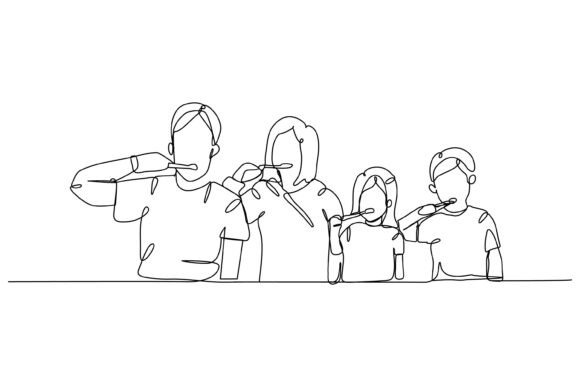
The aesthetic of modern visual communication often leans toward reduction, seeking to convey complex emotional narratives through the simplest possible means. Within this paradigm, the continuous one line design of a family has emerged as a powerful stylistic choice for creators, educators, and brands alike. This specific artistic approach, particularly when depicting intimate daily rituals such as a family brushing their teeth together, transcends mere decoration. It serves as a functional visual metaphor for unity, routine, and health. When executed as a minimalist style vector illustration on a white background, this design format offers unparalleled versatility across digital and print media. Understanding the technical and conceptual underpinnings of this art form is essential for professionals looking to leverage its unique communicative power.
The Semantics of the Unbroken Path
At its core, a continuous line drawing is defined by the absence of interruption. The pen or digital stylus does not lift from the canvas until the image is complete. In the context of family imagery, this unbroken path carries significant semantic weight. Unlike traditional illustrations composed of separate shapes and layers, the single line suggests that every member of the family unit is intrinsically connected. There is no beginning and no end within the composition; there is only flow.
When applied to the specific scenario of a family brushing their teeth together, the continuous line reinforces concepts of shared habits and collective well-being. The act of oral hygiene is typically private, but transforming it into a synchronized, communal activity via art highlights themes of parenting, education, and domestic harmony. For healthcare providers, pediatric dentists, and wellness brands, this visual shorthand communicates safety and guidance without the clutter of photorealism. The viewer’s eye follows the line from parent to child, mirroring the transfer of knowledge and care that occurs in real life. This psychological engagement makes the continuous one line design of a family far more effective than generic stock photography for niche storytelling.
Technical Advantages of Vector Formats
The utility of these illustrations relies heavily on their file architecture. Deliverables typically include EPS, SVG, and JPG formats, each serving a distinct purpose in a professional workflow. While the JPG provides a rasterized preview suitable for quick mockups or social media posts, the true value lies in the vector-based EPS and SVG files.
- Scalability Without Degradation: Because vectors are defined by mathematical equations rather than pixels, a continuous one line design can be scaled from a business card icon to a billboard-sized mural without losing crispness. This is critical for branding consistency.
- Editability and Customization: In an EPS or SVG environment, the stroke color, weight, and even the curvature of the line can be modified instantly. A designer can adjust the illustration to match a specific brand palette or alter the composition to fit a narrow vertical layout without redrawing the asset.
- File Size Efficiency: Minimalist vector files are exceptionally lightweight. For web developers and UX designers, using an SVG of a family brushing teeth loads significantly faster than a high-resolution photograph, improving page speed scores and user experience.
- Clean Integration: The minimalist style on a white background ensures that the artwork integrates seamlessly into any layout. There are no distracting backgrounds or complex shadows to mask out, making compositing effortless.
Practical Applications Across Industries
The specific motif of a family engaging in dental hygiene through a continuous line aesthetic bridges multiple sectors. Its application extends beyond simple ornamentation, functioning as a strategic communication tool.
Pediatric Healthcare and Dentistry: Medical environments often struggle to balance clinical professionalism with child-friendly warmth. A continuous one line design of a family avoids the sterile look of medical diagrams while steering clear of the cartoonish aesthetic that some parents find unprofessional. It strikes a middle ground that feels educational yet sophisticated. Waiting room signage, post-visit instruction sheets, and website headers benefit from this balanced tone, reinforcing positive behavioral modeling.
Educational Materials and Parenting Resources: Educators and content creators focusing on early childhood development utilize these visuals to teach routines. The simplicity of the line art reduces cognitive load for young viewers, allowing them to focus on the action being depicted rather than extraneous details. In books, flashcards, or classroom posters, the continuous line acts as a visual anchor, helping children understand the sequence and social nature of self-care tasks.
Lifestyle Branding and Product Packaging: For companies selling eco-friendly toothbrushes, natural toothpaste, or sustainable bathroom accessories, packaging design must reflect values of purity and simplicity. A minimalist vector illustration aligns perfectly with clean-label marketing. The white background allows the product color to take precedence, while the line art adds an emotional layer that differentiates the product from competitors using generic clip art.
Design Considerations for Effective Implementation
While the continuous one line design of a family appears simple, achieving clarity requires careful consideration. Not all single-line drawings are created equal, and selecting or commissioning the right asset involves evaluating several factors.
Anatomical Abstraction vs. Recognizability: The challenge of continuous line art is maintaining recognizable human forms without the ability to use shading or internal detail. When depicting a family brushing teeth, the angle of the arm and the tilt of the head must be precise enough to read as "brushing" rather than "eating" or "waving." Professionals should review the silhouette of the design before acquisition to ensure the gesture is universally understandable at small sizes.
Line Weight and Hierarchy: In a minimalist style, the thickness of the stroke dictates the visual weight. A line that is too thin may disappear when printed on textured paper or viewed on low-contrast screens. Conversely, a line that is too thick can make delicate subjects like children appear heavy or clumsy. The ideal vector asset allows for stroke adjustment, enabling the user to calibrate the weight relative to the surrounding typography and layout elements.
Cultural and Demographic Representation: Even in abstract line art, representation matters. The proportions, hairstyles (if indicated by the line), and relative heights of the figures contribute to the inclusivity of the design. Creators and businesses must consider whether the continuous one line design of a family reflects the diversity of their audience. Fortunately, the editable nature of SVG and EPS formats allows for minor adjustments to better represent different family structures or characteristics, provided the base geometry supports it.
Integrating Vectors into Digital Workflows
For digital professionals, understanding how to manipulate these assets is as important as the design itself. When working with the SVG version of a family brushing teeth illustration, best practices involve optimizing the code for web use. Many raw vector exports contain unnecessary metadata or redundant nodes. Running the file through an SVG optimizer can reduce file size further without affecting visual quality.
Furthermore, CSS animation presents a unique opportunity with continuous line designs. Because the image is a single path, developers can animate the stroke-dashoffset property to simulate the drawing process in real-time. This "self-drawing" effect is particularly engaging for loading screens or interactive educational content, reinforcing the concept of continuity and progression inherent in the subject matter. This level of interactivity is impossible with raster formats like JPG, highlighting why acquiring the full suite of EPS, SVG, and JPG files is a necessary investment for comprehensive projects.
In print production, the EPS format remains the industry standard for compatibility with professional RIP software and large-format printers. However, designers should always verify that the spot colors or CMYK values are correctly assigned within the vector file before sending to press. While the minimalist style on a white background seems foolproof, ensuring the black or colored line is set to overprint correctly prevents unwanted white halos or registration issues during the printing process.
The Value of Minimalist Storytelling
Ultimately, the decision to utilize a continuous one line design of a family brushing their teeth together is a strategic choice favoring clarity over complexity. In an era of information saturation, audiences respond to visuals that respect their time and intelligence. This art form strips away the non-essential, leaving only the pure relationship between the subjects and the action they share.
Whether used to sell a product, teach a habit, or brand a service, the minimalist vector illustration serves as a flexible foundation. By providing EPS, SVG, and JPG options, this design asset empowers users across the spectrum—from hobbyists creating personal scrapbooks to researchers publishing papers on family health dynamics. The enduring appeal of the unbroken line lies in its ability to say more with less, proving that even the most routine aspects of family life can be elevated through thoughtful, disciplined design.