Evaluating the Pine Tree Forest Path with Green Bushes Vector for Nature-Themed Design Projects
Selecting the right visual asset for a nature-themed project requires balancing aesthetic appeal with technical versatility. The Pine Tree Forest Path with Green Bushes vector illustration offers a specific solution for designers and content creators seeking a calm, daylight forest scene featuring a winding yellow dirt road. Unlike generic stock photography or abstract patterns, this resource provides a structured, scalable composition that serves as a functional design element rather than mere decoration. Understanding the distinct characteristics of this illustration helps determine whether it aligns with your current project requirements or if an alternative visual style would be more appropriate.
Defining the Visual Composition and Atmosphere
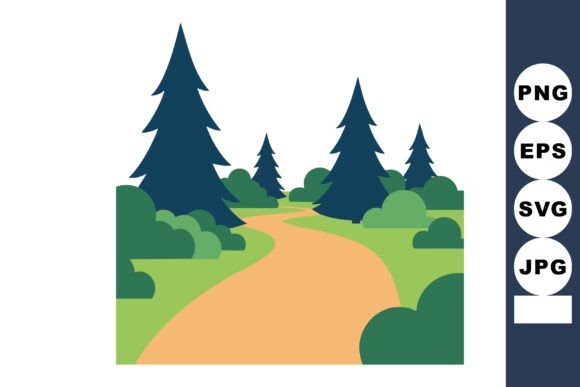
The primary value of the Pine Tree Forest Path with Green Bushes lies in its specific atmospheric rendering. The illustration depicts a bright daylight setting, which immediately distinguishes it from the moody, shadowed, or twilight forest imagery often found in digital asset libraries. This high-key lighting creates a sense of safety, clarity, and optimism, making it particularly suitable for projects related to eco-tourism, mental wellness, outdoor education, or sustainable living.
The composition relies on strong leading lines created by the winding yellow dirt road. In design theory, this serves a dual purpose: it adds depth to a two-dimensional plane and guides the viewer’s eye through the layout. For web designers and print layout artists, this negative space along the path is functional real estate. It allows for the integration of text overlays, call-to-action buttons, or logo placement without obscuring the essential environmental context. The green bushes provide a mid-ground texture that bridges the gap between the foreground path and the background pine canopy, ensuring the image feels layered and complete even when cropped or resized.
Vector Format vs. Raster Photography: Technical Tradeoffs
When comparing the Pine Tree Forest Path with Green Bushes to traditional raster photography, the decision often comes down to scalability versus photorealism. The downloadable ZIP includes SVG, EPS, JPG, and PNG files, offering flexibility across different media. However, users must weigh the inherent tradeoffs between these formats.
- Scalability and Resolution Independence: The SVG and EPS formats allow for infinite resizing without pixelation. This is critical for large-format printing such as billboards, trade show banners, or vehicle wraps where a standard JPEG would degrade. If your project spans multiple touchpoints—from social media icons to storefront signage—the vector version provides consistency that photography cannot match.
- Editability and Customization: Unlike a flattened photograph, the vector components are separated into layers. Designers can adjust the hue of the green bushes to match brand color palettes, modify the curvature of the yellow dirt road, or remove elements entirely to create a cleaner background. This level of control reduces the need for multiple asset purchases.
- File Size and Performance: SVG files are typically smaller in file size than high-resolution photographs, contributing to faster page load times on websites. However, complex vectors with thousands of anchor points can sometimes render slowly on older devices. Testing the specific SVG complexity is advisable before deployment.
- Aesthetic Limitations: Vectors inherently possess a stylized, illustrated quality. They lack the organic imperfections, light leaks, and textural nuance of camera-captured images. If the goal is documentary realism or evoking a visceral sensory response, high-end photography remains superior.
Comparing Stylized Illustrations Within the Category
Even within the category of forest vector art, not all assets serve the same function. The Pine Tree Forest Path with Green Bushes occupies a middle ground between flat iconography and detailed painterly illustration. When evaluating this against other options, consider the following stylistic distinctions:
Flat Design vs. Semi-Realistic Detail
Many modern vector packs utilize extreme minimalism, reducing trees to simple triangles and paths to solid geometric shapes. While these integrate well with tech-forward or corporate UI designs, they often fail to convey the serenity of a natural environment. The Pine Tree Forest Path with Green Bushes retains enough organic detail—such as the variation in bush foliage and the texture implied in the dirt road—to evoke a genuine sense of place. This makes it better suited for industries where emotional connection to nature is key, such as conservation non-profits or organic product branding, compared to ultra-minimalist alternatives.
Color Palette Versatility
Some forest illustrations rely heavily on gradients and complex shading to create depth. While visually striking, these can be difficult to recolor without breaking the lighting logic. This particular asset uses a brighter, flatter color application typical of clean vector art. This approach facilitates easier global color changes. If you need to shift the scene from summer greens to autumn oranges for a seasonal campaign, the simpler color structure of this illustration allows for rapid adaptation without requiring advanced gradient editing skills.
Best-Fit Scenarios and Practical Applications
Determining when to use this specific asset involves matching its attributes to user intent. Based on comparative analysis of design trends and usability, the Pine Tree Forest Path with Green Bushes performs best in the following contexts:
- Wayfinding and Signage Systems: The clear depiction of a trail makes this ideal for park maps, hiking guide apps, or directional signage. The stylized nature ensures legibility at small sizes and from distances, whereas photographic details might blur.
- Educational Materials: For textbooks, worksheets, or e-learning modules about forestry or ecology, the illustration provides a distraction-free representation of a forest ecosystem. It avoids the potential copyright issues of specific landmark photos and maintains a neutral, informative tone.
- Wellness and Mindfulness Content: The combination of bright daylight and a gentle, winding path psychologically suggests progress, journey, and peace. This aligns well with therapy practices, meditation apps, or self-help publications where aggressive or dark imagery could be counterproductive.
- Web Headers and Hero Sections: The horizontal aspect ratio and central focal point make it structurally sound for website headers. The yellow road draws attention toward the center or sides where navigation or headlines typically reside.
Limitations and When to Choose Alternatives
Despite its versatility, the Pine Tree Forest Path with Green Bushes is not a universal solution. Recognizing its limitations prevents misalignment between asset and objective.
Lack of Human Element: The scene is devoid of people. For projects requiring social proof, community engagement, or lifestyle aspiration, an illustration featuring hikers or families may be necessary. Adding human figures to an existing vector can be challenging if the art styles do not match perfectly.
Specific Botanical Accuracy: While labeled as "pine trees," vector art is often generalized. If your project requires scientifically accurate depictions of specific pine species (e.g., distinguishing between Lodgepole and Ponderosa pines) for academic or regulatory purposes, this stylized representation will be insufficient. Scientific illustration or verified photography would be the required alternative.
Nighttime or Low-Light Contexts: The bright daylight palette is baked into the design's logic. Converting this to a night scene requires more than just darkening the colors; it necessitates reworking shadows, adding light sources, and adjusting contrast ratios. If your primary need is a nocturnal forest atmosphere, sourcing a dedicated night-themed asset is more efficient than modifying this one.
Technical Considerations for Implementation
For professionals integrating this resource into workflows, understanding the file format nuances is essential for maintaining quality.
- SVG for Web: Use the SVG file for responsive websites. Ensure you optimize the code using tools like SVGO to remove metadata and unused definitions left over from the creation software. This preserves the crispness on retina displays while minimizing bandwidth usage.
- EPS for Print Production: Professional printers and sign makers generally prefer EPS files due to their compatibility with legacy RIP software and CMYK color space support. Always verify color profiles before sending to production to ensure the bright greens and yellows reproduce accurately on physical substrates.
- PNG for Quick Mockups: The included PNG serves as a convenient preview or placeholder for client presentations and internal mood boards. It should generally not be used in final production unless the resolution meets specific DPI requirements, as it lacks the scalability of the vector formats.
- JPG for Compatibility: While less versatile than PNG for design work due to lack of transparency support, the JPG ensures the asset can be opened in virtually any software, including basic office suites, for non-design stakeholders reviewing concepts.
Making the Final Selection Decision
Choosing the Pine Tree Forest Path with Green Bushes ultimately depends on the intersection of technical needs and emotional resonance. It excels as a flexible, editable, and optimistic visual foundation for projects that require a stylized yet recognizable natural setting. Its strength is not in hyper-realism, but in its ability to communicate the concept of a forest path clearly and adaptably across various media.
If your priority is absolute realism, scientific precision, or human-centric storytelling, you should continue exploring photographic or specialized illustrative alternatives. However, if you require a scalable, brand-adaptable asset that conveys tranquility and direction with clean lines and bright tones, this vector package represents a pragmatic and effective choice. By leveraging the included multi-format ZIP, designers can maintain visual consistency from initial concept sketches through to final large-scale production, maximizing the return on investment for this single visual resource.